The Sins of Akanda Episode 7- The Coffin Akanda Paid For
I didn’t go back to the compound.
I stood on the red road with the dust of Kehinde’s driver still hanging in the air and understood that I had perhaps four hours before that house closed around me, before Kehinde arranged whatever a careful man arranges for a niece who has spoken to the wrong woman. Four hours in which I was still a person who could walk where she chose.
So, I did not go home but went to find the mother.
Funke had told me, in the market, without knowing. A family everyone pities, and no one explains. There is only ever one such family in a town this size; everybody knows the address, and nobody says it out loud.
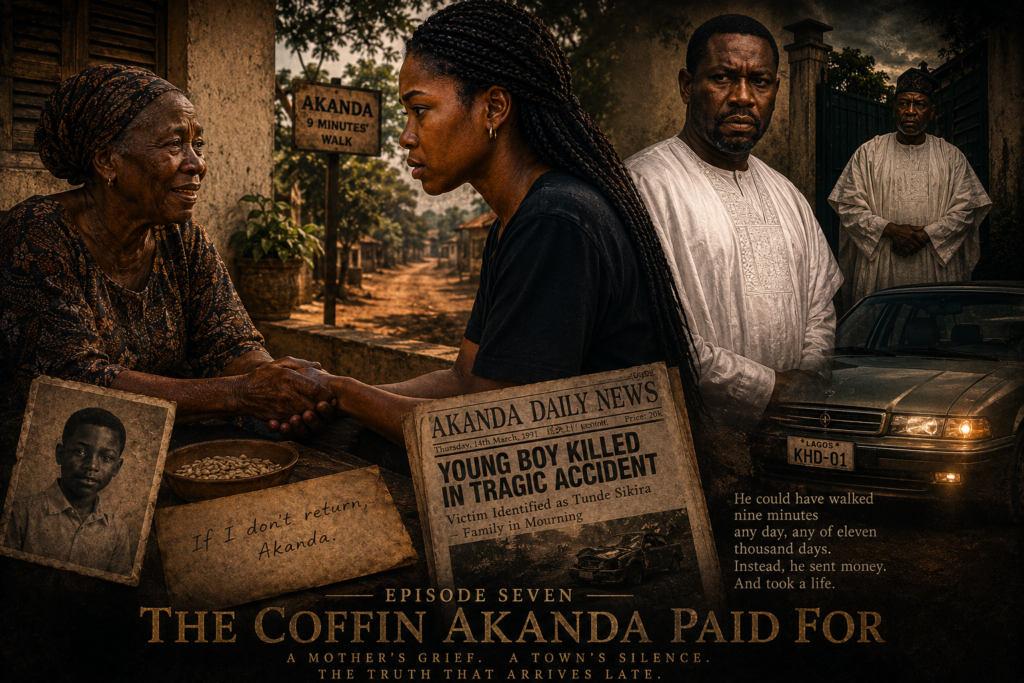
Her name was Mama Sikira, and she lived nine minutes’ walk from my father’s gate.
Nine minutes. Thirty years. He could have walked it in the time it takes to boil water, any day, any of eleven thousand days, and stood in front of her and said the thing; instead he sent money.
She was on the veranda shelling melon seeds into a bowl, an old woman with a face that had been kind for so long it had set that way, and when I came through her gate she looked up and her whole body changed. It softened, opened and lit.
“Ah!” she said. “Ah, Morenike. Look at you. Look at you.” She put the bowl down, pushed herself up, took both my hands in her dry, warm ones, and her eyes had gone wet. “You have come home for your father. Good girl. Good girl. He talked about you, you know. My own Baba. He said, “My daughter is abroad, she is doing well and she is clever like her mother.”
I stood in that gateway and let a woman my father had destroyed hold my hands and praise him to my face.
“Sit, sit,” she said. “You will drink something. Ah, Morenike, that man.” She shook her head, smiling, wiping her eye with the back of her wrist. “That man. When my Tunde died, you were small; you would not remember. When it happened, I had nothing. Nothing. His father had gone; my people had washed their hands and I could not bury my own son. Your father came here, to this veranda, where you are sitting, and he wept. A big man like that. He sat there, wept with me, and he paid for everything. The coffin, the service, the cloth, everything. Then he did not stop. School fees for Sikira, this roof, the shop and so on. Thirty years, Morenike. Thirty years that man carried me.”
She laughed a little, embarrassed by her own crying.
“People say a rich man’s kindness is never free,” she said. “They said it to me many times. I asked them, what did he ever take from me? Eh? What did Akanda ever take from Mama Sikira?”
She waited, pleased, expecting nothing, expecting me to smile.
I want to be very exact about what happened inside me on that veranda, because it is the hinge of this entire story and I have thought about it every day since.
I had come there to tell her.
I had walked nine minutes with Iyabo’s iron voice in my ears, “go and tell that woman who really took her child,” and I had been ready. Righteous, even. I had spent three days peeling a monster out of a saint and I thought the truth was a thing you owed people, flatly, like a debt.
Then I sat on that veranda and watched a seventy-year-old woman’s face while she thanked the man who killed her son.
It was then I understood what Iyabo had done to me.
She had not sent me to deliver the truth but to find out what it costs and to be the one who pays it, for once, instead of the Oyelarans, who had spent thirty years making other people pay for what they knew.
Here is what telling her would do. It would take the one good thing in an old woman’s life. The memory of a man who wept on her veranda and reveal it as the performance of the man who had ordered her child’s death. It would tell her that every school fee, this roof, the shop, thirty years of gratitude, was a murderer’s receipt. It would make her complicit, retroactively, in her own son’s erasure. It would put her, at seventy, in a witness box against the most powerful family in the town, with no proof but a photograph and a dead woman’s word.
It would not bring Tunde back.
That is the sentence Akanda had counted on. It’s the arithmetic every silent person in this town had run and lost. I sat there, ran it myself and felt, with a horror I still cannot fully describe, how reasonable the silence was. How gentle and how much like kindness.
Thirty years of a whole town choosing not to detonate an old woman’s peace.
That is how a monster gets called father. Not because people are wicked but because the truth arrives late, and always in the hands of someone who would have to break something beautiful to hand it over.
“What did he take from you?” I repeated.
“Nothing,” she said comfortably, settling back. “That is what I tell them. Nothing at all.”
“Mama.” My voice did not sound like mine. “How did Tunde die?”
Her hands stopped in the melon seeds.
It was very small. A hesitation of maybe a second but I read faces for a living, and saw it: not grief. Grief is loose and wet. This was the other thing. A tight, rehearsed, careful thing.
“It was an accident,” she said. “On the Ibadan road. At night.”
“Who told you that?”
“Everybody knows it.” She had not looked up from the bowl. “Your father told me. He was the one who came and told me. He said the driver never stopped; they never found the vehicle.”
“Did you see him? After. Did you see Tunde?”
“They said it was better not to.” Her voice had gone very flat, very quiet, and her hands had started moving again, mechanically, seeds falling into the bowl one after another. “Akanda said a mother should not see a thing like that. He said, let me carry this one for you. He arranged everything and closed the coffin. I did not see my son again after he went out of that door on a Thursday evening.”
The seeds went into the bowl.
“I have wondered,” she said, so softly I nearly missed it, “every day for thirty years, whether it was really him in that box.”
Then she looked up at me.
It was not a kind old woman’s face, at least, not anymore. The face of someone who has held a suspicion for three decades with no one on earth safe enough to say it to and who has just been asked a direct question, for the first time in her life, by an Oyelaran.
“Why are you here, Morenike?” she said. “Why are you asking me this? Today?”
I opened my mouth.
Then, out on the road, a car door closed.
It was not the grey Peugeot. I had been listening for it. This was a different engine, heavier, and it had come up the lane while we were talking and I had not heard it, because I had been looking into a face.
Footsteps in the yard. Unhurried. The walk of a man who knows exactly where he is going and does not need to arrive quickly.
Mama Sikira’s whole body changed again, the light coming back on, the setting face and the reflex of thirty years.
“Ah!” she called out, delighted, rising. “See who God has sent! Come, come, your niece is here; she has come to greet me…”
Kehinde stepped into the yard, in a clean white agbada, smiling his brother’s smile.
“Mama,” he said warmly, taking her hands in both of his exactly as I had. “I have been looking everywhere for this girl.” He turned the smile on me, and it did not reach anywhere near his eyes. “The family is worried about you, Morenike. Grief makes people wander. Come.” He held out his hand. “Let’s take you home.”
Behind him, in the gateway, stood the man in the clean white agbada I had last seen on the day after the funeral, the one who had asked the gateman, very politely, whether the body had been viewed before burial.
He was no longer asking questions but stood at Mama Sikira’s gate with his hands folded, watching me and waiting to see whether I would get into the car.
Next Week: Episode Eight – The Man Who Asked About the Body
Who was the man who came looking for Akanda’s body and why was he so certain he was dead? What did he really want to know?
Next week, I take you into the back of that car, where he finally tells me something that changes everything I thought I knew about my family.
Someone else had been investigating them all along. Watching, waiting and following a trail that began eleven years ago. Not until a witness with the right surname appeared.
I had been found.
The Sins of Akanda is a work of fiction. Any resemblance to real persons, living or dead, is coincidental. New episodes every week.
For Episode 6 –> https://tallwriter.com/the-sins-of-akanda-ep-6-5-words-on-the-photo/


1 Response
[…] For Episode 7 –> https://tallwriter.com/the-sins-of-akanda-episode-7-the-coffin-akanda-paid-for/ […]