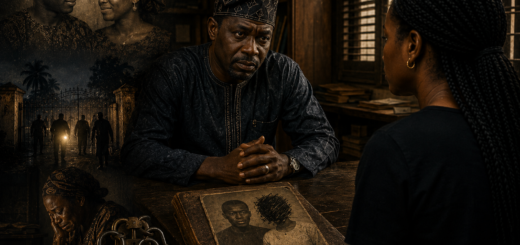
The Sins of Akanda- The Man They Buried Twice

They buried Chief Akanda Oyelaran on a Tuesday, and by Wednesday morning three different people had come to the family compound to make sure he was really dead.
The first was an old woman nobody recognised. She did not weep but stood at the edge of the freshly turned earth, looked at the mound for a long time, then spat once into the red soil and walked back the way she came. The second was a man in a clean white agbada who asked the gateman, very politely, whether the body had been viewed before burial. Viewed by who? , the gateman wanted to know, but the man was already gone. The third was a policeman who did not come in uniform.
In Akanda’s town, this was not considered strange. When a man like that dies, you check. You check the way you check a snake you have beaten with a stick , not because you saw it move, but because you cannot afford to be wrong.
I am telling you this story because i am the one who came back to bury him. He was my father. I had not spoken to him in eleven years. You will hear many things about Akanda Oyelaran before this series is finished, and i want to be honest with you from the first page: most of them are true.
He was generous. The roof on the mosque, the borehole that still gives water to half of the area, the school fees of children whose own fathers had run away, that was Akanda. People will tell you these things with tears in their eyes and they will not be lying.
However, the same hands that paid those school fees did other things and the town knew. That is the part that haunts me, even now. The town knew, and the town ate his rice anyway, danced at his daughters’ weddings, called him Baba wa , our father and looked the other way for thirty years.
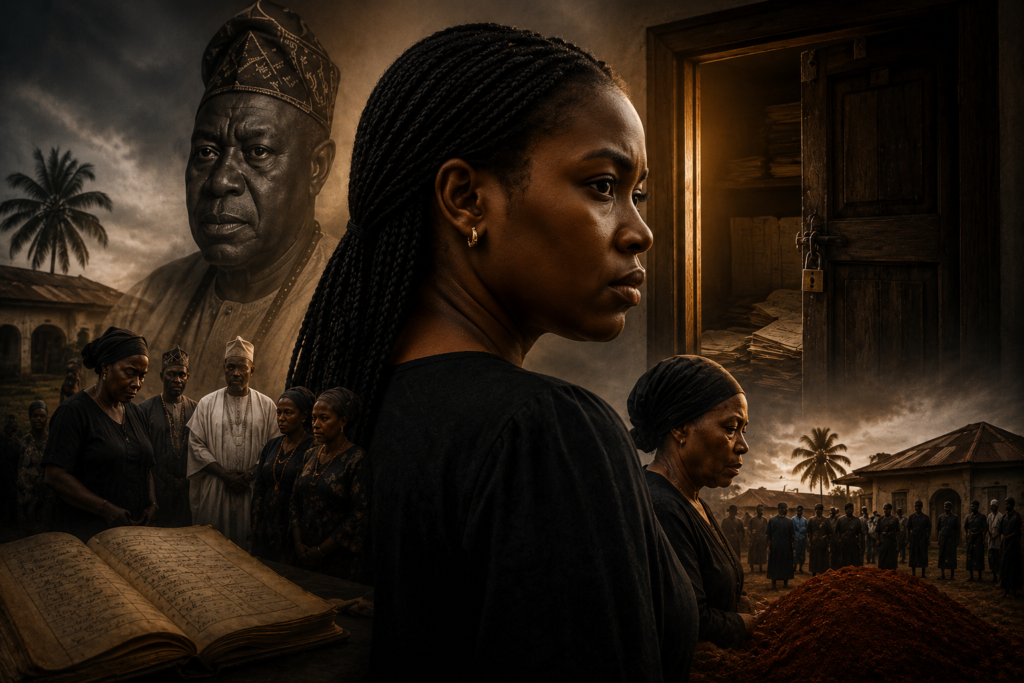
So whose sins are these, really? His? Or ours, for letting them happen, for needing him too much to ask the questions? That is what i came home to find out.
The compound was smaller than i remembered. Childhood does that; it inflates everything, the walls, the men, the fear. Standing in the courtyard as a grown woman, i could see the cracks in the plaster, the rust on the gate, the way the great Chief Akanda’s empire had been quietly rotting at the edges while he was still alive to deny it.
My aunt Funke met me at the door, held my face in both her hands and said the thing everyone says. “You came.” Then, lower, so the others would not hear: “There are things in his room you should see before your uncles get to them. Come tonight. Come alone.”
Here is what I did not yet know, standing in that courtyard: That Akanda had three families and only one of them knew it. That a man had gone missing in 1991 and his name was written in my father’s hand in a ledger i was about to find.
That the old woman who spat on the grave had once been the most beautiful girl in the region, and that my father was the reason she was not anymore. I did not know any of it. I only knew that the air in that house felt like a held breath, and that somewhere underneath all the weeping and the wreaths, the whole town was waiting to see whether the dead man’s sins would stay buried with him.
They would not.
*Next week, in Episode Two – “The Room He Locked”:
what Aunt Funke wanted me to find, and why my uncles arrived at dawn with a locksmith and a lie.*
*The Sins of Akanda is a work of fiction. Any resemblance to real persons, living or dead, is coincidental.
Episode Two — The Room He Locked
I waited until the compound was asleep. It takes a long time for a house in mourning to go quiet. There is always one more relative who wants to pray, one more woman in the kitchen scrubbing a pot that is already clean because her hands need something to do.
By two in the morning even grief gets tired, and the only sound left was the generator coughing in the dark and the dogs at the far end of the street arguing about something i would never know. Aunt Funke was waiting by the back stairs with a kerosene lamp and a face i did not recognise.
In the daylight she was soft, all cheek and laughter. In that yellow light she looked like a woman who had been carrying something heavy for a very long time and had finally found someone to hand a corner of it to.
“He kept it locked,” she whispered, leading me up. “Thirty years. Not even your grandmother went in. He said it was where he did his accounts.”
“… and you believe that?”
She stopped on the stairs and looked back at me, and for the first time i saw my father in her face, the same stillness, the same way of letting a silence answer for them. “I believe,” she said, “that a man does not put three locks on a room where he keeps money. Money he wants you to know about. It is the things he is ashamed of that need three locks.”
The door was at the end of the upstairs corridor, past the room where i was born. Three locks, exactly as she said; one old and heavy, two newer, shining, the kind you buy when the first one stops feeling like enough.
Funke took a key from inside her wrapper. One key.
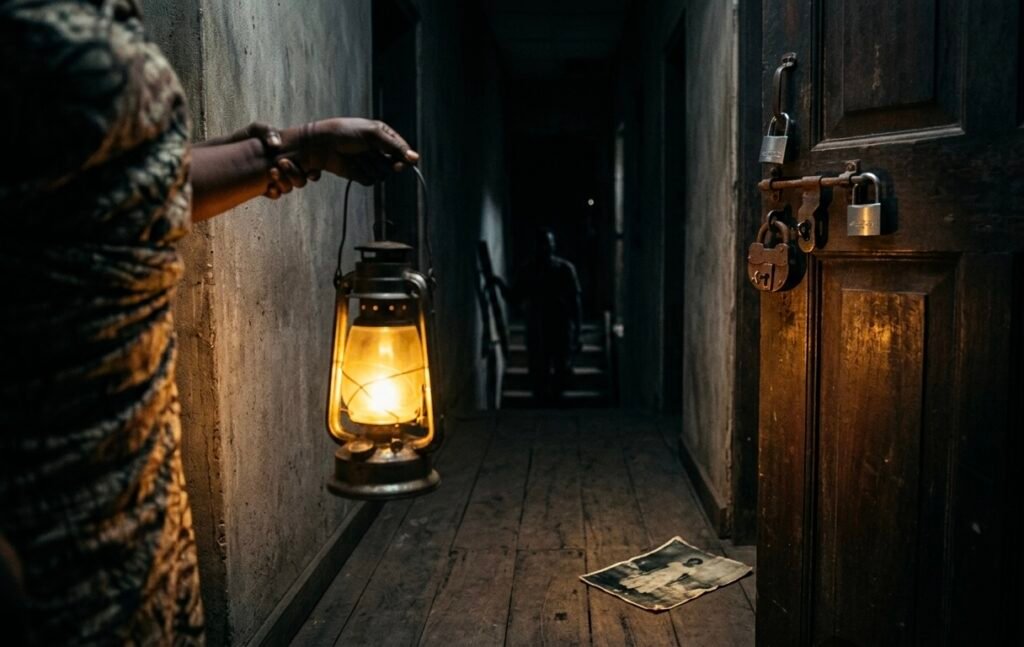
“I only have this one,” she said. “I took it from his body before they washed him. The other two…” she shook her head. “I have been trying for two days.
“The single key turned the old lock with a sound like a cough. The other two held. We stood there, the two of us, looking at a door that was now two-thirds still locked, and i understood something about my father that no eulogy had told me: he had been afraid.
All those years, all that power, “Baba wa,” the man the whole town checked twice to make sure was dead and he had lain in the room next door every night listening to the silence behind three locks, afraid of what would happen if the wrong person got in.
I put my hand flat against the wood. It was cold, then and i have asked myself a hundred times since whether i imagined it. I felt it give, just slightly. The way a door gives when it has not been locked at all, only pushed to.
I looked at Funke. “Did you say all three were locked?” Her face went grey in the lamplight. “All three. I tried them myself yesterday morning.”
I pushed. The door opened. Someone had been inside before us.
I want to tell you what was in that room, and i will. However, you have to understand the order in which i saw it, because the order is the whole story.
First: the smell. Old paper, kerosene, and underneath it something sweeter and worse that i did not let myself name.
Second: the desk. Heavy, colonial, the kind of furniture that outlives the empire that made it. On the desk, open, as if someone had been reading it minutes before, a ledger. Brown leather. My father’s handwriting, which i would have known anywhere, because it was the same handwriting that had signed the cheques that paid for my school and the letter, eleven years ago, that had ended us.
Third, and this is the thing my hand found before my eyes did, because i reached for the ledger and my fingers touched it first, a photograph, face down, that someone had placed deliberately on the open page. Placed, not dropped. Squared to the edge of the book like an exhibit. Like a message.
For me, i thought. Or for whoever came first.
I turned it over. Aunt Funke made a sound i had never heard a person make before. It was not a scream. It was smaller than that, and far worse, the sound of something inside her closing, a door of her own swinging shut after thirty years of being held open by hope.
“Where did he …” she started, and could not finish.
The photograph was old. 1980s, by the clothes. A young man, maybe twenty-five, laughing at whoever held the camera, one arm around a girl whose face had been carefully, completely scratched out with a pin. Hundreds of tiny strokes. Someone had sat with this picture and a needle and taken their time.
I did not know the young man but Aunt Funke did.
She was looking at him the way you look at the dead when they walk into the room and on the back of the photograph, in my father’s hand, in ink gone brown with age, were four words and a date.
I read them out loud because my aunt could not.”He came back. 1991.”
“Who is this?” I asked her. “Funke. Who is this man?” She would not look at me. She was looking at the door we had come through, the door that had been locked three times yesterday and open tonight. When she finally spoke, her voice had dropped to almost nothing.
“You should not have come tonight,” she said. “Someone wanted us to find this. Someone is still in this house who was here when …”
The generator died.
The whole compound dropped into black at once, the lamp a single trembling island, and somewhere below us, on the stairs we had climbed, i heard a sound that turned my blood to water.
A footstep. Then another. Coming up. Unhurried. The walk of someone who lived here. Someone who knew the house in the dark.
Aunt Funke’s hand closed around my wrist so hard it left marks i could still see in the morning. “Don’t make a sound,” she breathed. “If they know you’ve seen the ledger …”
The footsteps reached the top of the stairs.
Then stopped.
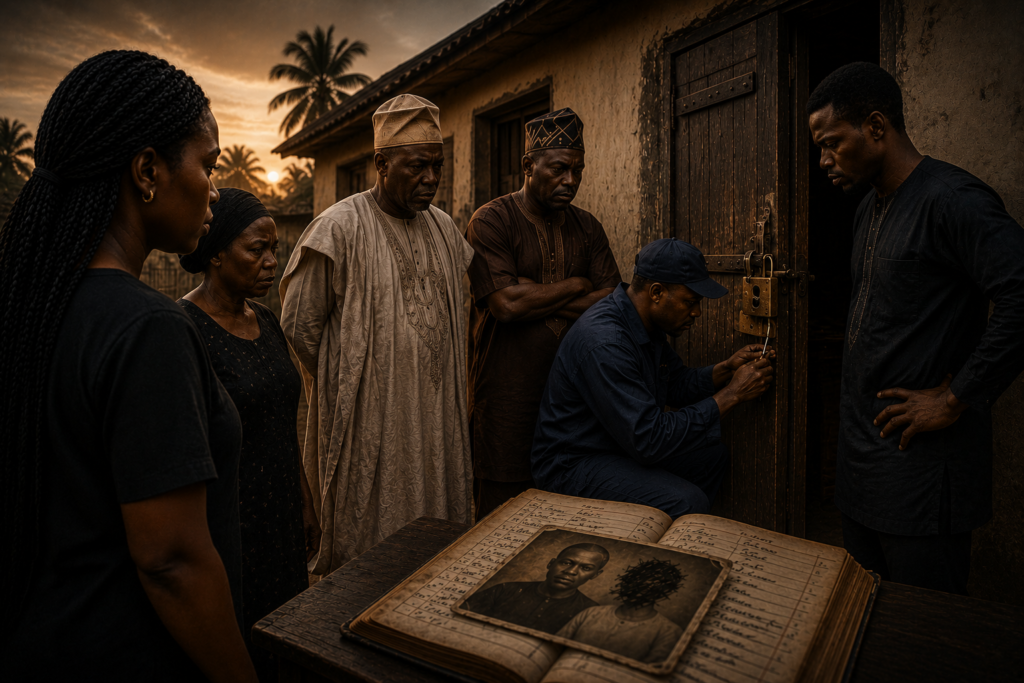
The room was already open. Yet at dawn, three uncles arrived with a locksmith and a story that did not add up.
One brother is searching for something, one is hiding something and one is terrified. By the end of the morning, a name from 1991 resurfaces, a forgotten photograph begins to speak, and Morenike discovers that the dead are not the only ones keeping secrets.
Sometimes the most dangerous lie is the one wrapped in the truth.
Episode Three: The Locksmith Arrives at Dawn
The footsteps did not come into the room. We stood in the dark, Funke’s nails in my wrist, the dead lamp, the photograph still warm from my own hand and we listened to whoever it was stand at the top of the stairs and breathe.
A long time. Longer than a person stands anywhere unless they are deciding something. Then they turned and went back down. Slow, unhurried and the same walk. Somewhere below, a door I did not know the sound of opened, then closed, and the house was ours again.
Funke let go of my wrist. In the dark I could hear her trying to make her breathing into something a person could survive on. “We put everything back,” she whispered. “Exactly.
The photograph face down, on the page, squared. Exactly how it was. If they come back and it has moved, they will know two people were in here, not one.”
“Two people?” “Whoever came first,” she said, “and us.”
I did not understand then why she was so certain there had been someone before us. I understand now. However, that morning I only did as I was told; laid the photograph back on the open ledger, face down, squared to the edge like an exhibit, my father’s four brown words pressed against the page where I could no longer see them but could not stop seeing them either.
*He came back. 1991.*
We left the room. Funke pulled the door to, and it held the way it had held against us; locked-seeming, unlocked in truth and we went down into the sleeping house. We did not speak again until morning, when it brought my uncles.
They came at dawn. All three of them and they brought a fourth man I did not know, who carried a canvas bag, and who would not meet anybody’s eyes.
A locksmith.
My uncle Taiye did the talking, because Taiye always did the talking. He was the eldest now that Akanda was gone, the new olori ebi (head of the family) and he wore the role like a borrowed coat that was slightly too big, tugging it straight every few minutes.
“Ah, Morenike,” he said, opening his arms to me as if eleven years were a thing you could cross in two steps across a courtyard. “You slept well? Good, good.
“Today is a difficult day. We must … there are documents. Your father’s papers. The land, the accounts, the ….” he waved a hand … “everything. The lawyers need them. We must open his study.”
“His study has a key,” I said. “Funke has it.”
The silence that followed was very small and very loud. Taiye’s smile did not move, but something behind it did. He looked at Funke, who immediately lowered her gaze to the ground.
“That key,” Taiye said gently, “opens one lock. There are three. Your father, God rest him, was a careful man. We have brought someone to help us be … careful also.”
There it was. The lie, it did not match what I knew, because I had stood in that room six hours earlier and the door had opened under my hand like a thing that wanted to be found.
They did not need a locksmith.
So either my uncles did not know the room had been opened in the night or one of them was the footstep on the stairs, and the locksmith was theatre, a performance of breaking in put on for the benefit of everyone who had not been there to feel the door give.
I looked at the three of them. Taiye tugging his coat straight, Kehinde behind him saying nothing, and the youngest, Dele, who had not stopped staring at the staircase since he walked in, the way a man stares at a thing that frightens him and I made the first real decision of this whole story.
I said nothing about the night. I let them break into a room that was already open.
The locksmith was good. The two new locks took him four minutes. When the door swung in, my uncles crowded the doorway, and I watched their faces instead of the room, because the room I had already seen and the faces I had not.
Taiye’s face: hunger, badly hidden. He went straight for the desk drawers. Kehinde’s face: nothing. A wall. He stood in the centre of the room and turned slowly, taking inventory, and I thought, *this one is the dangerous one,* and I have never since had cause to change my mind.
Dele’s face: I will remember his face until I die, because he looked at the desk, the open ledger, at the photograph squared on top of it and he went white. He said, before he could stop himself, in a voice that came out of a much younger man:
“He kept it.”
Then he caught himself. Closed his mouth, but it was too late, and he knew it was too late. He looked at me across that cursed room and we both understood that he had just told me he knew exactly what the photograph was.
Taiye had not heard as he was elbow-deep in a drawer. However, Kehinde had. He always heard. He turned his slow turn until he was facing his youngest brother, and he said, very mildly, in the voice you would use to ask about the weather:
“Dele. Why don’t you go and see about breakfast.”
It was not a question.
Dele went.
I followed him.
I found him in the back courtyard, by the borehole their brother’s money had built, gripping the rim of it with both hands and breathing like a man who has run a long way.
“Dele.”
He didn’t turn.
“The man in the photograph,” I said. “The one whose girl had her face scratched out. Who is he?”
For a long moment I thought he would do what everyone in that house had done my whole life; go still, let the silence answer, hand me nothing. He was Akanda’s brother and had been trained in the family religion of saying nothing.
However, Dele was the youngest, and they are always the ones who break, because they were children when it happened and children are not supposed to keep this kind of weight.
He turned around, eyes were wet, furious and twenty-five years old.
“You really don’t know,” he said. “All these years away, and nobody told you. Of course they didn’t.” He laughed, an ugly sound.
“His name was Bayo and he was my friend. He was the best man any of us ever knew, and your father ….”He stopped.
Looked past me.
I turned.
Kehinde was standing in the doorway, perfectly still, perfectly calm, and he had been there long enough. He smiled at me, and it was Akanda’s smile, the exact one, the one the whole town had eaten rice under for thirty years.
“Morenike,” he said warmly. “You must be tired. You’ve had such a long journey home.” A pause. “… and you’ve already seen so much.”
The way he said *seen* told me he knew about the night. He knew the door had been open and had always known. He had been the footstep on the stairs.
“Come,” Kehinde said, holding out his hand to me across the courtyard, the way you hold out a hand to someone standing too close to the edge of a well.
“Let me tell you about your father. Let me tell you everything. It’s time somebody did.”
God help me, because I wanted the truth more than I wanted to be safe. I took his hand.
Next week, in Episode Four — “What Kehinde Said”: the story my uncle told me in the dead man’s study, the year 1991, and the night a young man named Bayo walked into this compound alive and did not walk out.
Every word Kehinde spoke was true. That was how I knew he was lying.
Episode Four — What Kehinde Said
He took me back up to the study. The room where it had all started and i noticed he chose it deliberately, not the parlour nor the shade of the mango tree, but the one room in the house with three locks and a dead man’s ledger, as if to say: whatever I tell you here, the walls have heard it before.
He sat behind Akanda’s desk, his brother’s chair. The ease with which he did it told me more than anything he said afterward. He had sat in that chair before. Many times. This was not a room he was seeing for the first time. It never had been.
“Sit,” he said. I sat, as he folded his hands on the desk, over the closed ledger, and he looked at me with my father’s eyes in a face that had learned to be kinder than my father’s ever was, and he began.”Your father,” Kehinde said, “did not kill Bayo.”
I had not asked. That is the first thing you should notice. I had not said the word “kill,” and nobody had.
Bayo was a man who “came back,” then a photograph, a scratched-out face and a year. I had built a death in my own head out of scraps, and here was Kehinde answering the accusation before I had made it, which is what a man does when he has been rehearsing the answer for thirty years.
“I never said he did,” I said. Something flickered, but was gone before I could name it. “No,” he agreed smoothly. “… but you were going to think it. Everyone thinks it and it is easier to think it. So let me give you the truth instead, Morenike, because you are his daughter, you have a right to it, and because ….” he glanced at the door, “because your uncle Dele has a soft heart and a loose mouth, and I would rather you heard this from someone who was actually there.”
Here is the story Kehinde told me. I am giving it to you the way he gave it to me, because you need to hear it in his shape before I tell you where the shape is wrong.
In 1990, he said, Bayo was engaged to a girl named Iyabo. She was, by every account, the most beautiful girl in three towns, the girl in the photograph, the one whose face someone had later sat and destroyed with a pin. Bayo loved her, everyone knew it and their wedding was set. However, Bayo, he said, was ambitious in a dangerous way. He had gone to Lagos, gotten involved in business he should not have, the kind of business where men lend you money and the interest is not paid in money.
He came back to town in 1991 owing people who do not forgive debts, frightened and desperate.”He came to your father,” Kehinde said. “As everyone came to your father. Baba wa. The man who fixed things. Your father …,” here Kehinde spread his hands, the very picture of regret “your father tried to help him and he gave him money. A great deal of money but the men Bayo owed were not the kind you pay once. They came here, to this compound. Looking for him.”
He leaned forward.
There was a night in 1991, Morenike, when violent men came through that gate looking for Bayo. In the confusion of that night, he ran.
He ran, he did not stop and he never came back. Iyabo waited for him for two years, then her mind broke, and that is the woman you may have seen at the graveside spitting on the earth. That is the whole tragedy. Your father did not kill anyone. He was the only man who tried to “save” him. Yet, the town, which never forgives a rich man for the sin of being needed, decided it was easier to whisper that Akanda had done something terrible than to admit that the world is simply cruel and money cannot buy a man out of every grave he digs for himself.”
He sat back. “That is what happened,” he said. “That is 1991 and I was there. I am the only one still alive who was in this compound that night and I am telling you the truth.”
Here is the thing that made the hair stand up on my arms:I believed him.
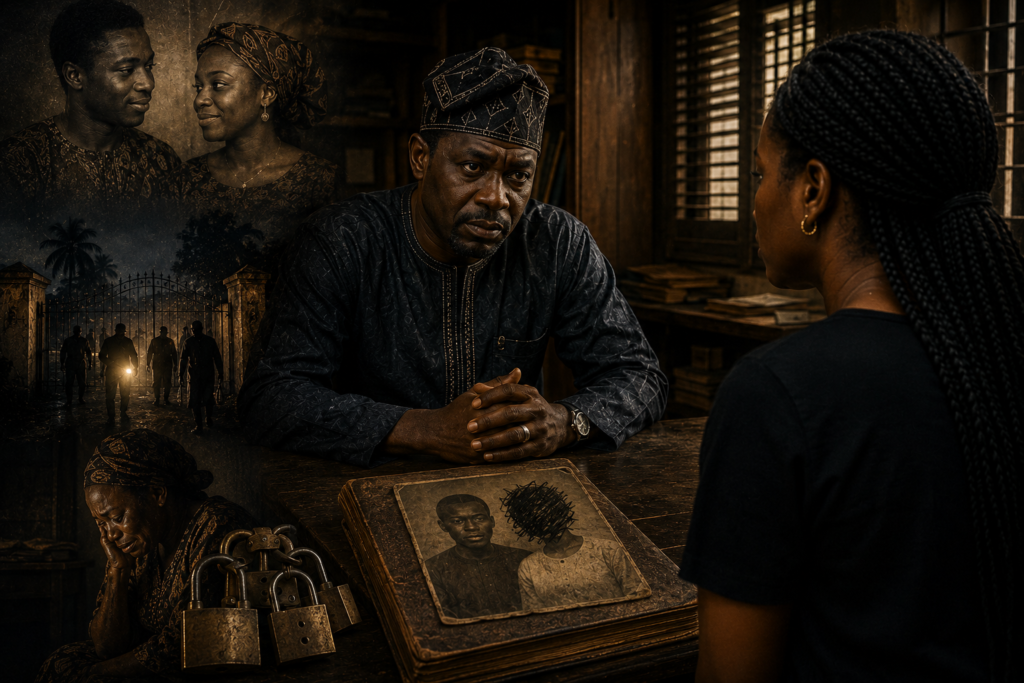
Every word rang true. The dates fit. The debt and Iyabo’s broken mind fit the woman at the grave. Bayo the desperate gambler fit the laughing young man in the photograph. It was a complete, closed, sorrowful story, and it made my father a good man undone by another man’s weakness, and it explained everything. It explained “everything.”
That was the problem.
Thats because I had spent eleven years away from this family learning a trade, and I have not told you yet what that trade is, so I will tell you now: I am a claims investigator. I sit across desks from people who have lost things; houses, cargo, husbands, etc,. I listen to them explain how it happened, and my entire job, the thing I am good at, the thing that pays my rent in a cold country far from this warm cursed compound, is knowing the difference between a person remembering and a person reciting.
Kehinde was reciting.
A man remembering a night thirty years ago fumbles. He says “I think,” “it must have been” and “what was her name again.” He gets the weather wrong and argues with his own memory. Grief and time sand the details down.
Kehinde got nothing wrong. Not one date or one name and sequence. His story was smooth, as a stone that has been turned over in a pocket for thirty years, because that is exactly what it was. Not a memory. An object, made once, polished ever since, kept ready for the day someone like me finally came home and had to be handed it.
Every word he spoke was true.That was how I knew he was lying, because the truth, when it is real, has edges and there was not one edge in the whole of it. I did not tell him any of this. I let my face be a daughter’s face, soft, grieving and grateful. I said thank you and that it helps to finally understand. I was tired, which was true, and I let him walk me to the door of the study with his hand warm on my shoulder. At the door I stopped, as if a small thing had just occurred to me. As if it were nothing.
“Uncle,” I said.
“The photograph with Bayo and Iyabo. Someone scratched out her face, sat with a pin and destroyed it, very carefully, over a long time.” I looked up at him. “If Iyabo is the one who lost her mind waiting, and Bayo is the one who ran, then who was still angry enough, thirty years later, to do that to her picture? Why would my father keep it locked in a room with three locks, if the story is only sad and not shameful?”
For one second, a second, Kehinde’s face did the thing I had come four thousand miles to see. It went still, the Akanda stillness. The silence that answers so you don’t have to. Then he smiled again, patted my shoulder, and said, “You have your father’s mind, Morenike. He would have been proud.”
Then he went down the stairs.
However, he had given me the second I needed, because a man who has told you the whole truth has nothing left to go still or freeze about.
There was more.
There was a great deal more and someone in this compound had scratched out a “dead” girl’s face with a needle, one stroke at a time, long after she was supposed to be only sad.
Next week, in Episode Five — “The Woman at the Grave”
I go to find Iyabo, who is not mad and not “dead.” She has been waiting thirty years for someone from this family to be brave enough or foolish enough to knock on her door.
She told me something different and has kept something of Bayo’s all these years that my father would have burned this whole compound to the ground to destroy.