The Sins Of Akanda- Episode Four — What Kehinde Said
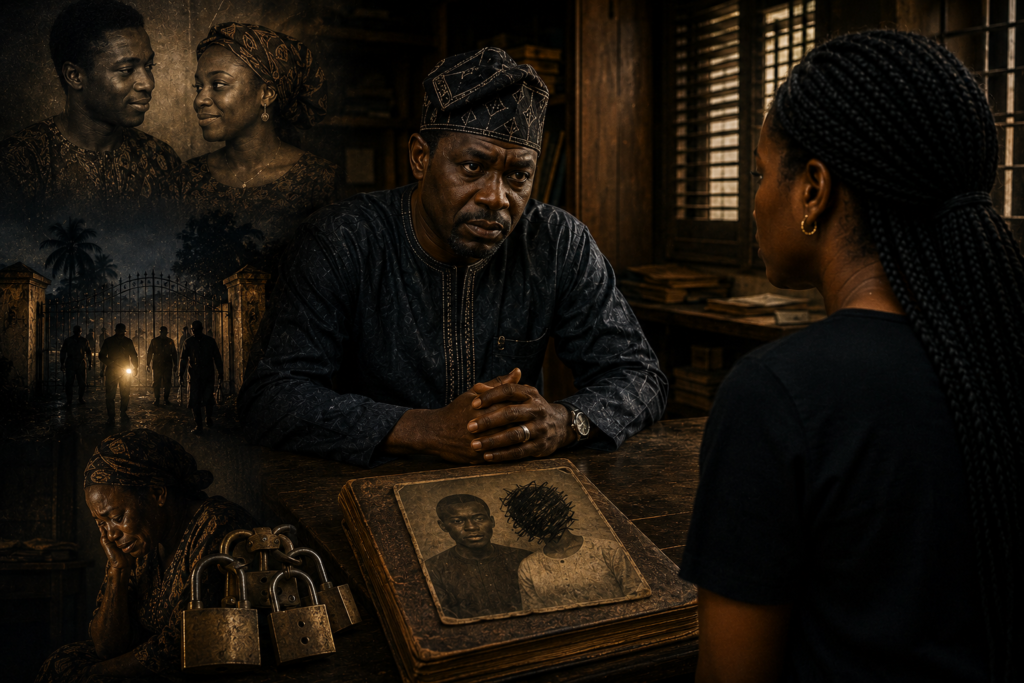
He took me back up to the study. The room where it had all started and i noticed he chose it deliberately, not the parlour nor the shade of the mango tree, but the one room in the house with three locks and a dead man’s ledger, as if to say: whatever I tell you here, the walls have heard it before.
He sat behind Akanda’s desk, his brother’s chair. The ease with which he did it told me more than anything he said afterward. He had sat in that chair before. Many times. This was not a room he was seeing for the first time.
It never had been.
“Sit,” he said. I sat, as he folded his hands on the desk, over the closed ledger, and he looked at me with my father’s eyes in a face that had learned to be kinder than my father’s ever was, and he began.
“Your father,” Kehinde said, “did not kill Bayo.”
I had not asked. That is the first thing you should notice. I had not said the word “kill,” and nobody had.
Bayo was a man who “came back,” then a photograph, a scratched-out face and a year. I had built a death in my own head out of scraps, and here was Kehinde answering the accusation before I had made it, which is what a man does when he has been rehearsing the answer for thirty years.
“I never said he did,” I said.
Something flickered, but was gone before I could name it. “No,” he agreed smoothly. “… but you were going to think it. Everyone thinks it and it is easier to think it. So let me give you the truth instead, Morenike, because you are his daughter, you have a right to it, and because ….” he glanced at the door, “because your uncle Dele has a soft heart and a loose mouth, and I would rather you heard this from someone who was actually there.”
Here is the story Kehinde told me. I am giving it to you the way he gave it to me, because you need to hear it in his shape before I tell you where the shape is wrong.
In 1990, he said, Bayo was engaged to a girl named Iyabo. She was, by every account, the most beautiful girl in three towns, the girl in the photograph, the one whose face someone had later sat and destroyed with a pin. Bayo loved her, everyone knew it and their wedding was set.
However, Bayo, he said, was ambitious in a dangerous way. He had gone to Lagos, gotten involved in business he should not have, the kind of business where men lend you money and the interest is not paid in money. He came back to town in 1991 owing people who do not forgive debts, frightened and desperate.
“He came to your father,” Kehinde said. “As everyone came to your father. Baba wa. The man who fixed things. Your father …,” here Kehinde spread his hands, the very picture of regret “your father tried to help him and he gave him money. A great deal of money but the men Bayo owed were not the kind you pay once.
They came here, to this compound. Looking for him.”
He leaned forward.
“There was a night in 1991, Morenike, when violent men came through that gate looking for Bayo.
In the confusion of that night, he ran. He ran, he did not stop and he never came back. Iyabo waited for him for two years, then her mind broke, and that is the woman you may have seen at the graveside spitting on the earth.
That is the whole tragedy. Your father did not kill anyone. He was the only man who tried to “save” him. Yet, the town, which never forgives a rich man for the sin of being needed, decided it was easier to whisper that Akanda had done something terrible than to admit that the world is simply cruel and money cannot buy a man out of every grave he digs for himself.”
He sat back. “That is what happened,” he said. “That is 1991 and I was there. I am the only one still alive who was in this compound that night and I am telling you the truth.”
Here is the thing that made the hair stand up on my arms:I believed him.
Every word rang true.
The dates fit. The debt and Iyabo’s broken mind fit the woman at the grave. Bayo the desperate gambler fit the laughing young man in the photograph. It was a complete, closed, sorrowful story, and it made my father a good man undone by another man’s weakness, and it explained everything. It explained “everything.”
That was the problem.
Thats because I had spent eleven years away from this family learning a trade, and I have not told you yet what that trade is, so I will tell you now: I am a claims investigator.
I sit across desks from people who have lost things; houses, cargo, husbands, etc,. I listen to them explain how it happened, and my entire job, the thing I am good at, the thing that pays my rent in a cold country far from this warm cursed compound, is knowing the difference between a person remembering and a person reciting.
Kehinde was reciting.
A man remembering a night thirty years ago fumbles. He says “I think,” “it must have been” and “what was her name again.” He gets the weather wrong and argues with his own memory. Grief and time sand the details down.
Kehinde got nothing wrong.
Not one date or one name and sequence. His story was smooth, as a stone that has been turned over in a pocket for thirty years, because that is exactly what it was.
Not a memory. An object, made once, polished ever since, kept ready for the day someone like me finally came home and had to be handed it. Every word he spoke was true.
That was how I knew he was lying, because the truth, when it is real, has edges and there was not one edge in the whole of it. I did not tell him any of this. I let my face be a daughter’s face, soft, grieving and grateful. I said thank you and that it helps to finally understand. I was tired, which was true, and I let him walk me to the door of the study with his hand warm on my shoulder.
At the door I stopped, as if a small thing had just occurred to me. As if it were nothing.
“The photograph with Bayo and Iyabo. Someone scratched out her face, sat with a pin and destroyed it, very carefully, over a long time.”
I looked up at him. “If Iyabo is the one who lost her mind waiting, and Bayo is the one who ran, then who was still angry enough, thirty years later, to do that to her picture? Why would my father keep it locked in a room with three locks, if the story is only sad and not shameful?”
For one second, a second, Kehinde’s face did the thing I had come four thousand miles to see. It went still, the Akanda stillness. The silence that answers so you don’t have to.
Then he smiled again, patted my shoulder, and said, “You have your father’s mind, Morenike. He would have been proud.”
Then he went down the stairs. However, he had given me the second I needed, because a man who has told you the whole truth has nothing left to go still or freeze about.
There was more.
There was a great deal more and someone in this compound had scratched out a “dead” girl’s face with a needle, one stroke at a time, long after she was supposed to be only sad.
📖 The Sins of Akanda – A family saga from Oyo State.
A dead man. A town that called him”father” while checking, twice, that he was really gone. A daughter who came home to bury him and found out what he buried.
← Previously: Episode 1 – 3 — The Locksmith Arrives at Dawn : [https://tallwriter.com/the-sins-of-akanda-episode-1-the-man-they-buried-twice/]
→ Next: Episode 5 — The Woman at the Grave