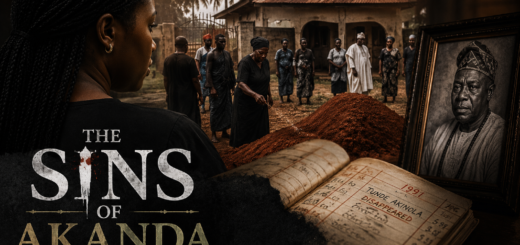
The Sins of Akanda – Episode 5 – The Woman at the Grave
It took me two days to find out where Iyabo lived, and I had to lie to everyone in the compound to do it.
Kehinde watched me now. Although not openly, as he never did anything openly, but I felt it the way you feel weather changing. A stillness in the house that followed me from room to room.
Twice I came around a corner and found Taiye where he had no reason to be, tugging his coat straight and pretending to look for something. Once, I woke in the night certain someone had just been standing in my doorway, and the air in the corridor still held the smell of a man who had left it a moment before.
They were not going to let me wander.
So I told them I wanted to visit the market. To buy cloth, I said, for the final funeral rites, a thing a grieving daughter would do, a thing so ordinary that even Kehinde could not object to it without showing his hand.
Funke came with me, which I had counted on and when we reached the market I took her hand, the way she had taken mine that first night, and said:”Take me to Iyabo. I know she isn’t “dead.” I know she isn’t mad and I think you have always known where she is.”
She looked at me for a long moment, in the noise, in the heat, in the colour of a hundred stalls and something in her that had been holding for thirty years let go.”He said if I ever went to her,” she whispered, “he would tell your grandmother what I did in 1988.”
She wiped her face quickly, roughly. “Your father kept everybody’s sins, Morenike. That was his real fortune. It’s not the land but the sins. He knew one thing about every person in this town, that is why they called him father and that is why they checked twice that he was dead.”
Then she straightened.
“He is dead now,” she said. “Come. It is not far.”
Iyabo lived on the far edge of town where the tarred road gives up and becomes red earth. In a small clean house with a garden that had been loved. That was the first lie of Kehinde’s to fall apart.
A madwoman does not keep a garden like that; rows of ugu and tomato, a frangipani heavy with flower, everything tended, everything “chosen.”
This was the home of a woman in complete possession of her mind, who had simply decided, long ago, to keep it pointed away from the town that broke her. She was at the door before we reached it. She had watched us come up the path and looked at me, not at Funke, at me, with an attention so total it stopped me where I stood.
“You have his walk,” she said. “Akanda’s daughter. I wondered which of you would come and i hoped it would be a daughter. The sons of that house were never brave.” She stepped back from the door. “Come inside before the whole street sees you and send the frightened one home.”
She meant Funke.
“What I have to say is not for people who still live under that roof.”
Funke went. She was glad to go, I think. Some truths you spend your whole life not wanting to be in the room for.
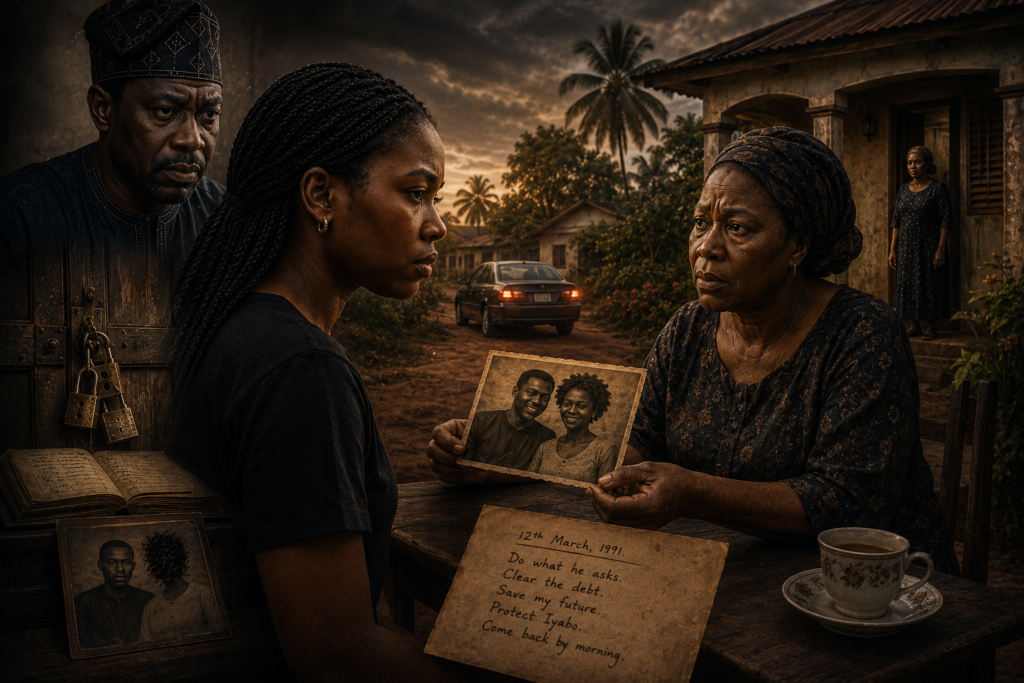
Inside, she made tea and her hands did not shake. She was perhaps sixty, still beautiful in the way a cliff is beautiful, worn to something essential and hard. When she sat across from me she did not begin with Bayo. She began with a question.
“What did they tell you happened to him?”
So I told her. All of it. Kehinde in the dead man’s chair, the debt, the men from Lagos, Bayo running through the gate and never stopping, Iyabo waiting two years and losing her mind. I told it exactly as Kehinde had told it to me, and I watched her face while I did, the way I watch faces for a living.
She did not get angry. That is what I remember. A woman hearing the official lie of her own life told back to her, and she only nodded slowly, as if confirming something on a list. “Smooth,” she said when I finished. “Isn’t it. It has no edges.”
I felt the skin move on my arms. “Those were almost my exact words.” “Of course they were.” She almost smiled. “You have his mind. Kehinde has spent thirty years sanding that story down. He has told it so many times it has worn a groove. However, I will tell you the part the groove was built to hide, and you will know it is true, because it will not be smooth. It will be ugly, will not fully make sense, and that is what real things are like.”
She set down her cup.
“Bayo did owe money,” she said. “That much is true, they always keep one true bone in the middle so the whole lie has something to stand on. Also, some men did come but Bayo did not run, Morenike. He came here, to this house, to me, the night the men were coming, and he told me he had found a way out.
He was happy. He was veryhappy. He said Akanda had offered him something. A way to clear the whole debt in a single night. He would not tell me what. He said it was better I didn’t know, that afterward we would marry, leave town and never speak of it.”
Her voice did not break, but it went very low. “He kissed me. He said, “wait up for me, I’ll come back by morning.” Then he went to your father’s compound to do whatever it was Akanda had asked of him.”
She looked at me.
“He did come back. Kehinde even told you that. He came back in 1991, he can’t help himself, that man, he hides the truth inside true words.
Bayo came back but not to me. They brought him back into that compound after whatever was done was done, he did not walk in on his own legs, and he never walked out again. I have spent thirty years knowing exactly which corner of that house holds him, because a girl who loved a man knows when he has stopped being anywhere else in the world.”
I could not speak. The tea went cold between us.
“What did my father ask him to do?” I finally said. “What was the way out?”
Then she stood, went to a wooden box on a shelf, the kind of box you keep the few things that matter, took out something wrapped in cloth gone soft with age, and she unwrapped it on the table between us with the care of someone handling a relic.
It was a photograph, although not the one in the study. This one was whole. Bayo, laughing, his arm around her and her face, untouched, radiant, the face someone in that compound had later hunted down in the other copy and destroyed with a pin.
However, it was not the front of the photograph she wanted me to see. She turned it over. On the back, in a hand that was not my father’s, a younger, rougher hand, Bayo’s own, was written a single line. A date, three days before he disappeared and beneath it, five words that Bayo had written to himself, the way a frightened man writes down a thing so that if something happens to him, it will not vanish with him.
I read them and then I understood, all at once and far too late, what my father had really been. He’s not a man undone by another man’s weakness. Something else. Something the whole town had eaten rice under for thirty years while checking, twice, that he was dead.
Iyabo watched me read it.
“Now you know what the sins of Akanda are,” she said quietly. “The question is what you will do, now that you are the only one of his blood who knows and now that Kehinde knows you came here.”
Outside, on the red road, a car I did not recognise slowed as it passed the house. Then slowed and stopped.
*Next week, in Episode Six
“Five Words on the Back of a Photograph”: what Bayo wrote, what my father asked him to do that night in 1991, and whose car was waiting on the red road when I walked out of Iyabo’s door.
The truth about Akanda is worse than murder and I am about to learn it was never only about Bayo.
*The Sins of Akanda is a work of fiction. Any resemblance to real persons, living or dead, is coincidental.
New episodes every week.*
For Episodes 1-4 —> https://tallwriter.com/the-sins-of-akanda-episode-1-the-man-they-buried-twice/