The Sins of Akanda – Ep 6 – 5 Words on the Photo
The car on the red road did not drive away.
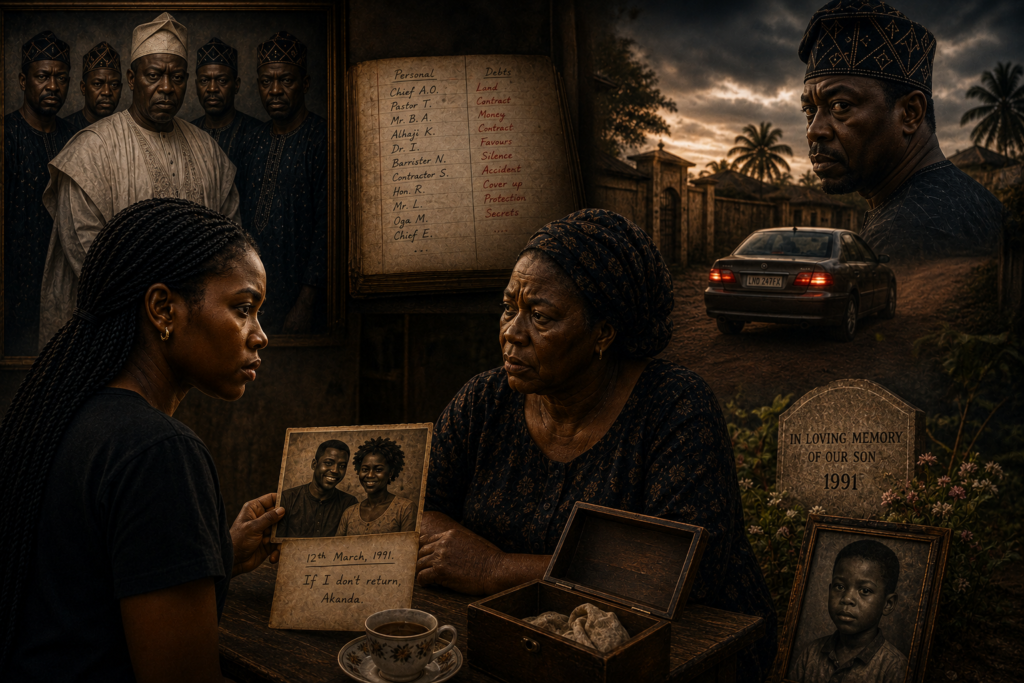
I watched it through Iyabo’s window, a grey peugeot, dust-coloured, the kind of car that is invisible precisely because there are ten thousand of them. It sat with its engine running.
Nobody got out and Iyabo, who had lived thirty years at the edge of this town watching that road, came, stood beside me and looked at it without fear, the way you look at a dog you have already decided is not brave enough to bite.
“Kehinde’s driver,” she said. “Not Kehinde. He would never come himself but sends the boy to sit and be seen, so that you will know you were followed and that fear will do the work he is too careful to do with his own hands.”
She turned from the window. “Sit back down, Akanda’s daughter. Finish reading. Let him wait. Thirty years he made me wait, let his driver taste one afternoon of it.”
So I sat back down, turned the photograph over again, and made myself read the five words in Bayo’s own rough hand, slowly, the way you read a thing you already know is going to change your life.
“If I don’t return, Akanda.” That was all. It was not a sentence nor an explanation. A man in a hurry, frightened, writing down the only thing that mattered in case he became a body that could no longer speak, the name of the person to blame. An arrow drawn by a dead hand, pointing back across thirty years, straight at the man they had just buried on a Tuesday while three strangers came to check that he was gone.
“He wrote it here, at this table,” Iyabo said. “The night he went. He would not tell me what your father had asked him to do, he said it was better I didn’t know, that if it went wrong the not-knowing might save my life. He was not a foolish man and knew he might not come back. So he wrote those words, pressed the photograph into my hands and said, “if I am not here by morning, this is who did it. Keep it. Don’t take it to the police, he owns the police. Keep it until someone comes who is stronger than he is.” Her voice thinned.
“Then he smiled at me, so I would not be afraid, and he went.
No one strong enough ever came. Until you walked up my path with his walk in a woman’s body.”
“What did my father ask him to do,” I said. “You said you didn’t know, but you have had thirty years, Iyabo. Thirty years to think about it. You know. Tell me what you think it was.”
She was quiet for a long time.
Outside, the grey Peugeot idled. “Your father,” she said at last, “was not always a rich man. That is the thing the young people in this town have forgotten. When I was a girl, the Oyelarans were nobody. Then, in the space of a few years, a very few years, they were everybody.
Land, cars, the school, the borehole. People said Akanda was clever. Some said he was blessed.” She looked at me. “People did not ask the other question. The question you ask when a poor man becomes a rich man overnight and stays rich for thirty years while everyone around him withers.
What did he give, to get it and what does a thing like that ask to be fed, to keep giving.”
The room went cold in a way the afternoon did not explain.
“You’re saying it was ….” “I am saying,” she cut in, gently, firmly, a woman who had decided long ago exactly how far she would say a thing out loud, “that Bayo owed money, your father offered to clear the whole debt in a single night, and that no ordinary night’s work clears a debt like Bayo’s.
I am saying that whatever Bayo did in that compound, he did it believing it would set him free and that it did the opposite. It did not free him. It bound him, because after that night, your father did not own Bayo’s debt anymore.” She leaned forward, and now her voice was barely a breath. “He owned his soul.” He had made him do a thing that Bayo could never take back, never confess, never outrun, something that made Bayo, forever, your father’s creature. That was your father’s real fortune, Morenike. Not the land. He collected people by making them do the unforgivable, then he owned the unforgivable, and a man cannot run to the police about another man’s crime when he is standing in the middle of his own.”
I thought of Funke in the market.
“Your father kept everybody’s sins. That was his real fortune.” Two women. The same sentence. Thirty years and half a town apart. It was true. “Then why is Bayo dead?” I asked. “If he was bound or was owned, my father had what he wanted. Why kill him?”
This was the edge. The ugly, non-smooth, doesn’t-fully-make-sense edge that Iyabo had promised me real truth would have.”… because Bayo was not like the others,” she said, and for the first time her composure broke, and I saw the girl she had been, the most beautiful girl in three towns, who had waited up all night for a man who came back only as a secret in the ground.
“The others your father bound, stayed bound. They ate the rice, danced at the weddings, called him father and were quiet, because being quiet let them keep their lives and their names. However, Bayo could not carry it. Whatever he was made to do that night, was too heavy for him, and within three days he told your father he was going to confess. All of it. Take his own punishment and bring Akanda down with him.”
She wiped her eyes, furious at them. “He came here first. He told me he’d found the courage to make it right. He was glad, Morenike. He kissed me, said soon we would be clean, free and we would leave. Then he went back to that compound one last time to tell your father to his face that he would not be owned.”
She stopped.
“… and a man who owns people by making them do the unforgivable,” she finished, “can’t allow even one of them to become forgivable again. Bayo confessing would have unlocked every other sin in that ledger. Every man in this town your father owned. It would have brought the whole thing down. So Bayo did not walk out of that compound and the town, which knew, which always knew, decided it was easier to say he ran to Lagos than to admit that their father had swallowed a good man whole for the crime of growing a conscience.”
I did not speak. I could not. The tea had gone cold twice now.
There was a thing I had not asked yet, because I had been afraid of it since the study, since Kehinde’s line. It was never only about Bayo, so I did it now.
“Iyabo. The thing my father made Bayo do that night, the unforgivable thing.” I made myself say it. “Who did Bayo hurt? Whatever he was made to do, was done to someone. There is another person in this. Isn’t there?”
For the first time all afternoon, she would not look at me. She stood, went to the window, looked at the grey peugeot idling on the red road, and was quiet for so long I thought she would not answer at all.
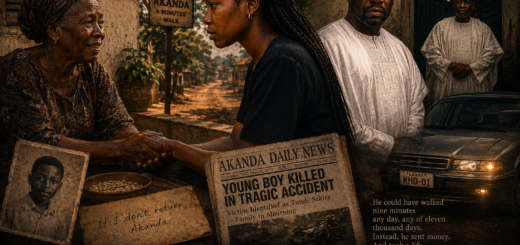
“There is a family in this town,” she said finally, to the glass, not to me. “A family everyone pities and no one explains. A mother who lost a child in 1991, was told it was an accident, and given a great deal of money by your father to help with her grief. She has spent thirty years not understanding why the man who killed her child paid for the coffin, wept at the graveside and became, God forgive us all, her greatest benefactor.”
She turned around.
“You want to know the last of your father’s sins, Akanda’s daughter? Don’t come back to me. I have carried my share. Go and knock on that door and tell that woman who really took her child. Then …” her voice was iron, “we will see whether you have your father’s mind, or only his walk.”
Behind me, on the red road, I heard the grey Peugeot’s engine finally shift into gear. It was not driving away. It was driving to the compound to tell Kehinde where I had been, and everything I now knew.
Next week, in Episode Seven – “The Coffin Akanda Paid For – a child lost in 1991, an accident that was never an accident, and a secret my father forced Bayo to carry will finally come to light. I have spent this entire story asking what the sins of Akanda were, only to discover that some answers are better left buried. Then I return to the compound and find Kehinde waiting because the driver got there first.
The Sins of Akanda is a work of fiction. Any resemblance to real persons, living or dead, is coincidental. New episodes every week.
For Episode 5 –> https://tallwriter.com/the-sins-of-akanda-episode-5-the-woman-at-the-grave/