The Sins of Akanda Episode 8- The Man Who Asked About the Body
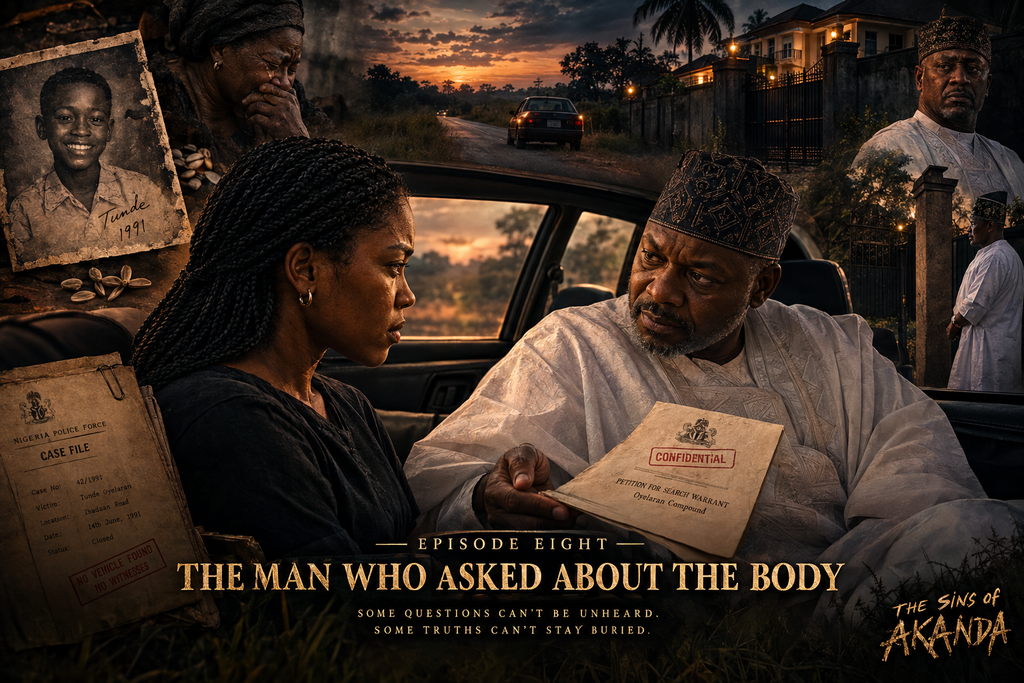
I got into the car.
I want you to understand why, because from the outside it looks like the most foolish thing a person could do. A woman who has just learned her family buries its problems, climbing willingly into a vehicle sent by the man doing the burying. However, I had run the arithmetic on that veranda and ran a different one now, in the space of three seconds, watching Kehinde’s hand held out to me and the stranger folded and waiting in the gate.
If I refused and made a scene in front of Mama Sikira, it would put her in it.
Kehinde would smile, soothe, drive away and then, some quiet week later, an old woman who had started asking questions would have an accident on a road at night, the way her son did, and the town would say “ah, poor Mama Sikira, God rest her,” and check twice that she was gone.
I had learned, in three days, exactly how this family kept people safe: by keeping them useless. Iyabo survived thirty years because she stayed at the edge of the road with a scratched-out photograph and told no one. Funke survived by swallowing what she saw in 1988. The whole town survived by being worth more to Akanda quiet than dead.
So I made myself worth more quiet. I smiled at Mama Sikira, said I would come again, and got into the car, because the car was the safest place for everyone but me. Kehinde did not get in. That was the first thing that surprised me. He closed my door with the gentleness of a man tucking in a child, tapped the roof twice, and stepped back.
The driver was the grey-Peugeot boy, and the man in the white agbada, who had asked about the body, got in beside me. The car pulled out of Mama Sikira’s lane but did not turn toward the compound. It turned the other way, towards the Ibadan road. The road where Tunde died.
For a while the man said nothing. He was older than I’d thought, sixty, perhaps, with the still hands and unhurried eyes of someone who had spent a professional lifetime letting other people fill silences. I knew the type. I was the type. Two investigators in the back of a car, each waiting for the other to spend a word first.
I lost. I am younger. “You asked the gateman whether the body had been viewed,” I said. “The morning after the funeral. Why?” He turned his head slowly, and something in his face eased, not a smile, but the settling of a man who has finally heard the right question after a long wait for it.
“… because in thirty years of this work,” he said, “I have learned that the Oyelarans are very good at closed coffins.” He let that sit. “Your uncle thinks I am here to make sure Akanda is dead. He is half right. I came to make sure Akanda is dead, the way I need him to be, in the ground, past helping, past buying his way out one last time. This is because a man like your father does not truly die, Morenike, until the last person who is afraid of him watches the earth go over his face. I needed to watch and have waited eleven years to watch.”
“Who are you?”
“My name would mean nothing to you.” He looked out at the road going by. “… but I will tell you what I am, which is more useful. I am the person your father’s money could not reach. Every judge, every officer, every witness in this state, Akanda owned, frightened or fed them. Except me. I do not live here and do not need anything he had.
Eleven years ago a woman came to me, at the very edge of her own life, gave me a name and a photograph, then asked me to do the one thing no one in this town could do.” He turned back to me. “Build the case, quietly and completely. Then wait for the day Akanda was in the ground and a witness with his own blood was ready to open her mouth.
“The car slowed. We were on the Ibadan road now, the long dark stretch, and the driver was pulling gently onto the shoulder, into the tall grass, into the exact kind of nowhere where a Thursday-evening accident is arranged.
Every muscle in me went to water. I had been wrong and had gotten into the car after all. The man saw it. He raised one hand, “wait,” and there was something almost gentle in it. “I am not going to hurt you,” he said. “I brought you here because you should see it once, in daylight, with someone who knows.
This is where they say Tunde died.” He nodded at the empty grass, the tar, the culvert. “No skid marks were ever recorded, no vehicle was ever found and no other driver ever came forward. An accident with no accident in it.
I have the police file, what there is of it, which is four lines and a payment I traced to your father’s account nine days later.” He looked at me. “Tunde did not die here, Morenike. Nobody died here. This place was chosen because it explains a body that was never really examined and a coffin nobody was allowed to open. Your father did not need a road. He needed a story with a road in it.”
“Then where is Tunde,” I said. My voice had gone somewhere small. “You already know,” the man said quietly. “You have known since the study. There is only one place in this whole affair that has three locks on it and a family that will bring a locksmith at dawn rather than let a daughter wander into it. Your father did not keep his sins in a ledger, whatever the women told you. The ledger is only paper. He kept his sins where he could stand over them every day and be sure they stayed quiet.
“The compound. The room I was born beside. The smell under the paper and the kerosene that I had not let myself name. “Bayo,” I said. “… and …””… and the boy Bayo was made to kill, to clear a debt that was never really about money.” The man’s voice did not change, and that steadiness was the most frightening thing in the car. “Your father needed a death for reasons the women have half-told you and I will tell you fully another day.
He did not want to spend his own hands on it. So he found a desperate man, Bayo, and he gave that desperate man a target and a promise: “do this, and your debt dies with him.” Bayo believed him and did it. The target, the boy chosen because his mother was poor, alone and would take a coffin and a story and be grateful …”
He did not finish. He did not have to.
Tunde. Mama Sikira’s Tunde. Killed by Bayo. Bayo killed by Akanda. Both of them, thirty years, nine minutes from her gate, under three locks, while she wept with gratitude on a veranda for the man who ordered it and the coffin he so kindly paid for.
“That is the sin worse than murder,” the man said. “He did not simply kill a child, but made one broken man murder another, so that the guilt would belong to Bayo and the power would belong to him. Then he comforted the mother of the dead boy for thirty years, in person, with his own arms, because a man who can do that, one who can hold his victim’s mother while she thanks him, that man is not afraid of God, Morenike.
A town learns very fast to be more afraid of him than they are of God.”
The car sat in the tall grass. Somewhere a bird was going about its evening as though the world were an ordinary place.
“Why me,” I said finally. “You have a photograph, a police file and eleven years. Why do you need me?”
“… because a photograph is a dead woman’s word against a buried man. A traced payment is a coincidence a good lawyer dissolves in an afternoon.” He leaned forward, and for the first time the stillness cracked and I saw the thing underneath it, old and patient and absolutely relentless. “… because the only thing in this world that can open that room lawfully, that can put a magistrate’s order on three locks and bring what is under them into the light where the whole town has to look, is a direct descendant of Akanda Oyelaran petitioning for it. His own blood asking the state to open his own father’s house.”
He sat back.
“For eleven years there was no such person willing. His sons will never do it; they are in the ledger themselves. Then he died, you came home for the funeral, walked up Iyabo’s path with his walk in a woman’s body and started asking the exact questions I have waited a decade to hear someone ask.”
He held out his hand. In it was a folded document, official, stamped and waiting.”I had it drawn up the day you landed,” he said. “All it needs is your name. However, you have to understand what it is before you take it. The moment you sign, you are no longer Akanda’s grieving daughter. You are the Oyelaran who opened the room. Your uncles will know. The town will know and some of what comes out of that room, Morenike …” his eyes did not leave mine, “will have your family’s name on it in ways you are not ready for. I have read the file and you have not. There is a reason your father sent you abroad, and kept the others close. You were not the one he was protecting.”
The document sat in his open hand, between us, in the grass, on the road where nobody died.
“You were the one he was afraid of,” he said. “Even then.”
Next week, in Episode Nine – “The Room, Lawfully Opened”: I read the file, learnt why I was sent away at eleven and never allowed to come back. I found out that the sins of Akanda have some other names in them too.
The Sins of Akanda is a work of fiction. Any resemblance to real persons, living or dead, is coincidental. New episodes every week.
For Episode 7 –> https://tallwriter.com/the-sins-of-akanda-episode-7-the-coffin-akanda-paid-for/